In short: you can connect Rivile (a Lithuanian accounting and ERP system) to your online store, CRM and bank in three ways: with ready-made Rivile integrations (WooCommerce, Shopify, PrestaShop, banks), through the Rivile REST API with n8n or Make, or with import files. The first Rivile ERP API key is free up to 100 requests a month; larger volumes cost €15–120/month. A custom flow is needed when you need two-way sync or several systems.
I checked the Rivile documentation and prices on rivile.lt, guide.rivile.cloud and gidas.rivile.lt on October 17, 2026. Rivile is a separate Lithuanian accounting system, unrelated to B1.lt (now Site.pro). I am not affiliated with UAB Rivile.
Rivile GAMA or Rivile ERP: what integration options are there?
The first question before any integration: which Rivile do you use? Almost everything depends on it.
| Rivile GAMA | Rivile ERP | |
|---|---|---|
| Type | Installed system (on the client's computer or server) | Cloud system, from €19 per user/month (Mini), from €25 (Standard) |
| API | Rivile API v2 (REST web services) via Manorivile-Gateway installed next to the database | Public REST API (OpenAPI 3), base address erp.rivile.cloud/public-api |
| Requirements | A valid version access agreement or the GAMA-2 package | The API key is created in the system |
| What the API can do | Purchase / sales documents (e.g. EDIT_I06_FULL), products, prices, stock (GET_I17_LIST), debts (GET_I06_DEBT), POS | Sales orders and invoices, purchase invoices, products, prices, inventory, payments, customers, contacts, deliveries |
| Limits | Depend on the server and the Gateway | GET up to 100 records per request, POST up to 5 MB, up to 100 document lines per request, response within 5 min. |
| API price | First key free up to 100 requests/month, then by volume | ≤100: €0, ≤1,000: €15, ≤10,000: €30, ≤100,000: €60, ≤1 million: €120/month |
The practical consequence: with Rivile ERP you can build the integration straight from n8n or Make in the cloud. With GAMA, Manorivile-Gateway has to be running on a computer or server that can reach the database; if that computer is switched off at night, the integration will not run at night. One Rivile ERP API key is meant for one company and one purpose (e.g. one online store or a CRM), so several systems need several keys.
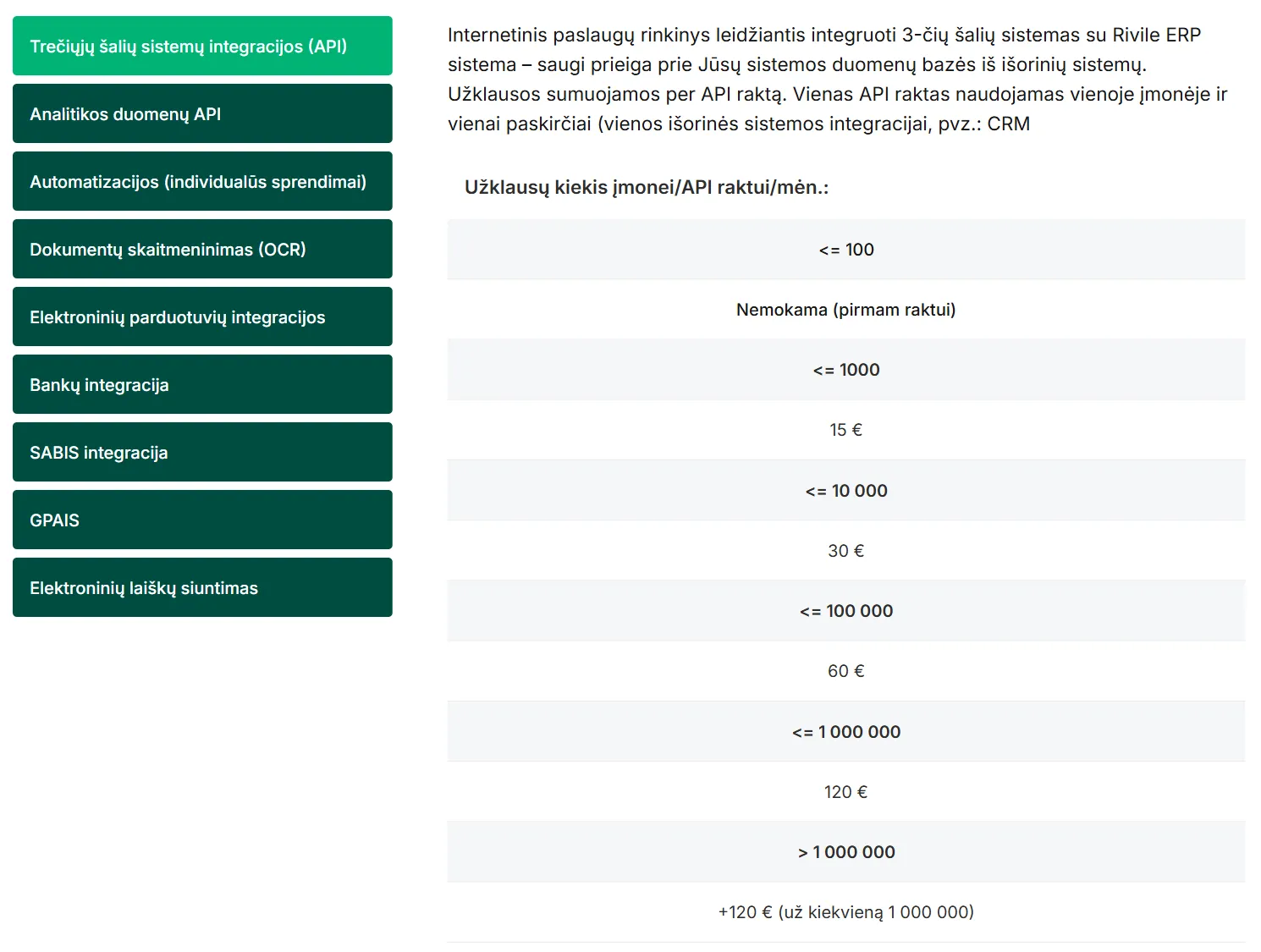
- 1 One API key = one company and one purpose (e.g. a CRM)
- 2 Up to 100 requests free for the first key
Ready-made Rivile integrations: WooCommerce, Shopify, PrestaShop
Before ordering a custom integration, check whether a ready-made one is enough. The Rivile ERP guide describes WooCommerce, Shopify, PrestaShop and iVesk.lt integrations, and the price list separately lists online store, bank and SABIS (the Lithuanian public e-invoicing system) integrations.
- Rivile ERP + WooCommerce. In the settings you enter the store address and the WooCommerce REST API keys, choose whether to import orders or invoices, and map payment methods (e.g. bacs, paypal, stripe). The import runs as an automation task; errors show up in the action history.
- Rivile ERP + Shopify. You create an app in Shopify with permissions to read orders, products and inventory and to write inventory; Rivile receives the Client ID and Secret.
- Rivile GAMA + WooCommerce / Shopify. The import program is placed in the GAMA folder and its settings adapted by Rivile or its partners under a separate contract; it needs Manorivile-Gateway and a certain GAMA version. The import is started with a programmed key in the sales list.
Ready-made integrations do one job well: they move sales into Rivile. They do not send stock and prices back to the store according to your rules, do not connect a CRM, do not send notifications, and usually run on demand rather than in real time.
Online store with Rivile: what to sync and how
| Data | Direction | Frequency | What to watch out for |
|---|---|---|---|
| Orders / invoices | Store → Rivile | Every 5–15 min. or when payment comes in | Order or invoice; whether the store or Rivile calculates VAT; the shipping line |
| Buyers | Store → Rivile | Together with the order | One shared customer code for individuals or a separate one for each; for companies, the company code and VAT code |
| Stock | Rivile → store | Every 15–60 min. or on change | Reserved quantities, several warehouses, matching product codes or barcodes |
| Prices and promotions | Rivile → store | Daily or on change | Which system is the “source of truth”: you cannot edit in both |
| Payments | Payment provider / bank → Rivile | Daily | Paysera and Stripe payouts are aggregated and need to be split by order |
The most common mistake is mismatched product codes. The Rivile import picks the product by barcode, code or sales code; if it cannot find it, the whole document is not imported. So before the integration it is worth aligning SKUs in the store and in Rivile. Another nuance is i.SAF (the monthly VAT invoice register filed with VMI, the Lithuanian tax authority): when you import purchases by individuals under one shared customer code, Rivile ERP keeps the customer name on the document, which is used when reporting to i.SAF. More about i.SAF: automating i.SAF filing.
CRM integration for your online store and Rivile
When the online store, the CRM and Rivile run separately, the same information is entered three times. A typical three-system model:
- Online store → CRM: new buyer, order history, cart value, for segmentation and repeat sales.
- CRM → Rivile: a B2B customer and won deal → the customer and a sales invoice or order in Rivile via the API.
- Rivile → CRM: debts and payments (GAMA: GET_I06_DEBT; ERP: payment and invoice statuses), so the account manager sees who is paying late before accepting a new order.
- 1Buyer and order history go to the CRMWooCommerce / Shopify
- 2B2B deal wonPipedrive / HubSpot
- 3Customer and invoice created via the APIn8n / Make → Rivile
- 4Debts and payments flow back to the CRMThe account manager sees who is paying late
Pipedrive, HubSpot and other CRMs have no direct connection to Rivile; the bridge is built with n8n or Make. How to choose a CRM: CRM automation for small businesses; online store processes: e-commerce automation and solutions for online stores.
Rivile and your bank: statements and payments
Rivile ERP has a direct bank connection through a licensed open banking provider (the guide mentions Swedbank, SEB, Luminor and Artea; the import is started from the payments window), as well as SEPA XML (camt.053) import with settings that remember customers and bank fees. Rivile GAMA imports XML statements and, with a separate API key that has Open Banking permissions, can import directly from the bank, for records no older than 3 months. If automatic debt settlement is set up for a customer, GAMA settles the debt itself when the payment is transferred.
What is missing: splitting Paysera or Stripe payouts by order and smart recognition of free-text payment references. I cover this in bank reconciliation automation.
When do you need n8n or Make, and what does the flow look like?
A custom flow makes sense when:
- you need two-way sync (orders into Rivile, stock and prices back);
- you have several stores, marketplaces (e.g. Pigu.lt, Varle.lt) or a B2B portal;
- a CRM, warehouse or courier system connects to Rivile;
- you need real time, not clicking an import button;
- you want error notifications and automatic retries.
Example: a WooCommerce → Rivile ERP flow in n8n:
- A WooCommerce webhook reports a paid order.
- n8n checks whether the order has already been imported (by order ID, to avoid duplicates).
- It finds or creates the customer in Rivile (by code: the API lets you pass a code instead of an ID).
- It matches products by SKU; if a product is missing, it stops and alerts you instead of creating a half-finished document.
- It creates a sales order or invoice with lines (longer documents are split into batches of 100 lines).
- It writes the Rivile document number back into the WooCommerce order note.
- A separate flow pulls stock from Rivile every 30 minutes and updates the store.
On choosing a platform: n8n or Make for a small business. Integration pages: Rivile, WooCommerce, Shopify.
How much does a Rivile integration cost?
| Item | Price (October 2026) |
|---|---|
| Rivile ERP license | From €19 (Mini) or €25 (Standard) per user/month; 30-day trial |
| Rivile ERP API key | €0 up to 100 requests; €15 up to 1,000; €30 up to 10,000; €60 up to 100,000 per month |
| Ready-made online store integration | According to the Rivile price list (ERP) or a contract with Rivile or a partner (GAMA) |
| n8n platform | From €20/month (Starter, billed annually) or your own server; Make: free plan with 1,000 credits |
| Custom flow (e.g. WooCommerce → Rivile with checks) | From €450; two-way sync or several systems priced by scope |
| Maintenance | From €150/month, if needed |
A rough estimate: a store with 500 orders a month, where each order needs several API requests (customer, document, lines) and stock is checked every hour, usually falls within the 10,000-request tier, i.e. €30/month for the Rivile ERP API. I can estimate the exact number once I know your order volume.
Where to start: 5 steps
- Identify your version. GAMA or ERP, which version, and where the database lives.
- Talk to your accountant. Orders or invoices, customer codes, VAT, accounts for payment methods.
- Align product codes in the store and in Rivile.
- Check the ready-made integration: it may be enough.
- Build a custom flow only for the missing part and test it with real orders in a test company.
I help with every step: you write which Rivile version and store you use, I reply by email, we arrange a call if one is needed, we agree on the price in writing before starting, and I set it up in 1–2 weeks. Service: process automation; for accounting: automation for accounting; prices: pricing page.
Frequently asked questions
Does Rivile have an API?
Yes. Rivile ERP (the cloud version) has a public REST API with OpenAPI (Swagger) documentation; authentication is an API key in the X-SessionToken header. Rivile GAMA has Rivile API v2 (REST web services), which run through the Manorivile-Gateway program installed on the client’s server and require a valid version access agreement or the GAMA-2 package.
How much does the Rivile API cost?
As of October 2026, the Rivile ERP API: the first key is free up to 100 requests a month, up to 1,000 costs €15, up to 10,000 €30, up to 100,000 €60 and up to 1 million €120 a month. The Rivile GAMA API also has a free limit of up to 100 requests for the first key; beyond that you pay by request volume (see the rivile.lt prices).
Can I connect WooCommerce or Shopify to Rivile without a developer?
Partly. Rivile ERP has ready-made WooCommerce, Shopify and PrestaShop integrations that the user configures in the settings. With Rivile GAMA, the import program is installed and adapted by Rivile or its partners under a contract. A custom flow is needed when you need more than importing orders: sending stock back to the store, several stores, a CRM or specific rules.
Should online store orders go into Rivile as orders or as invoices?
It depends on your process. If you still pick orders and reserve goods, import them as sales orders. If the store already issues the invoice, import them as sales invoices. Either way, agree with your accountant on a shared or individual customer codes, because that determines how the data gets into i.SAF (the Lithuanian VAT invoice register).
What is a CRM integration for an online store?
It is a connection that passes buyers and orders from the online store to the CRM (e.g. Pipedrive, HubSpot), so the sales team sees purchase history and marketing can segment customers. When Rivile is also in the picture, the CRM usually gets debt and payment data from Rivile, and Rivile gets new customers from the CRM.
How long does a Rivile integration take?
A simple one-way flow (e.g. WooCommerce orders into Rivile ERP) takes 1–2 weeks including testing. Two-way sync with stock, several stores and a CRM takes longer; we agree on the exact timeline and price in writing before starting, once it is clear exactly what needs to be connected.