SMB owners often spend many working hours a week on processes that could be automated: issuing invoices, moving data between systems, sending emails, routing leads, preparing reports. Even 10 hours a week adds up to about 500 hours a year, nearly three months of work. And still, the automation question stalls at one phrase: "how much does it cost?" This article gives concrete numbers, not round figures: three price tiers in euros, an ROI formula you can apply to your own business, and 7 typical automation examples for the Lithuanian market in 2026. For a broader overview of process automation, see (Process automation).
Quick answer: average automation cost and return
A pilot automation project (one process) costs €500–1,500. Full automation of one process with error handling and monitoring costs €1,500–4,000. A multi-process ecosystem covering several functions costs €4,000–12,000. Indicative payback for small companies: often 3–6 months. These are indicative ranges based on typical project scopes. The exact figure depends on three factors: process complexity, the tool used and the hours of work. More on calculating the return on automation: (AI agent ROI).
What determines the cost of process automation?
Process complexity (steps, integrations). A simple link between two systems, for example contact form → CRM, costs the least. Each extra integration or conditional logic (if X → do Y, otherwise Z) adds roughly 20–40% to the price. A process with 3 steps and one integration is a pilot. A process with 10 steps, 4 integrations and error handling is a full project. Before asking for a quote, sketch the process on paper: how many steps, which systems are involved, what the exception scenarios are.
Tool licenses (n8n, Make, Zapier, custom). The license costs €0 to €500/month depending on the tool and volume. Self-hosted n8n costs almost nothing (a VPS ~€10/month) but needs technical maintenance. Make (formerly Integromat): paid plans from ~€10/month (prices change), fast setup, intuitive interface. Zapier: the Professional plan from $19.99/month billed annually or $29.99 billed monthly (as of October 2026), the largest integration catalog, but relatively more expensive. A custom solution (Python + API): zero monthly fee, but higher setup costs. A detailed comparison of the tools for Lithuanian businesses' needs: (n8n vs Make vs Zapier 2026).
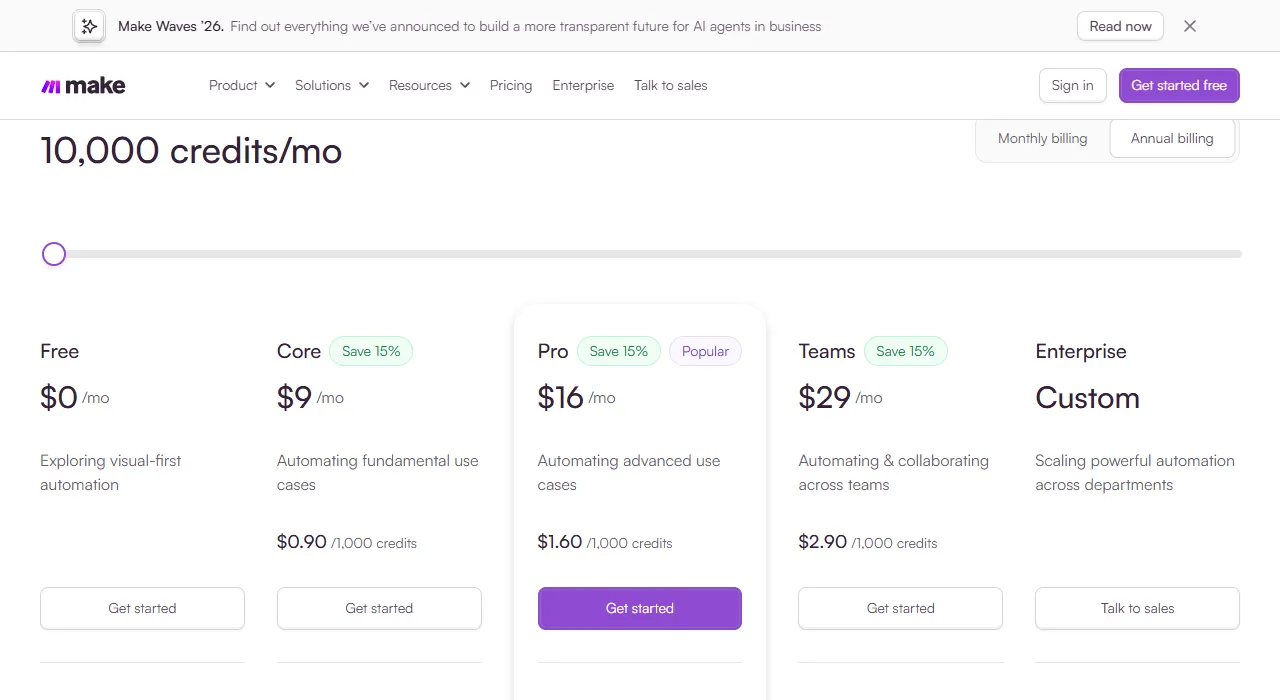
- 1 Selected number of credits per month
- 2 Core: the cheapest paid plan, usually enough for a simple process
Development and support hours. Most of the price is the specialist's working hours. An automation specialist in Lithuania costs roughly €40–80 an hour. A pilot takes 10–25 hours, a full project 30–80 hours, support 2–5 hours/month. Some agencies charge a fixed price, others an hourly rate. A fixed price is more predictable; an hourly rate is more flexible if requirements change during implementation.
How much does automation cost? 3 price tiers for 2026 (in €)
Pilot: €500–1,500. One process, 2–3 integrations, implemented in 1–2 weeks. Suits businesses trying automation for the first time that want to see results before a bigger investment. Examples: Google Forms → HubSpot sync; Shopify order → automatic email and accounting entry; new lead → Slack notification and CRM record. Support after launch: €50–100/month.
Full process: €1,500–4,000. More complex automation with error handling, conditional logic and data transformation. Implemented in 2–4 weeks. Examples: a full sales funnel from lead to invoice; automatic stock monitoring with orders sent to the supplier; distributing and escalating customer service tickets. Support: €100–200/month.
Multi-process ecosystem: €4,000–12,000. Several interconnected automation flows, a central database, report generation, AI components. Implemented in 1–3 months. Suits businesses that want to automate several functions and connect them into one system. Support: €200–500/month. At this level the payback is often fastest, because the biggest share of time costs gets automated.
How to calculate automation ROI: formula and 3 illustrative examples
Illustrative scenario: the companies and the numbers are built from typical processes and rough assumptions; these are not specific clients' results. Your numbers may differ.
ROI formula: (Working hours saved per month × Hourly cost equivalent) ÷ Investment = Months to payback. Example: you save 20 h/month, an employee costs the company €25/h, the investment is €2,000. 20 × 25 = €500 saved per month → 2,000 ÷ 500 = 4 months to payback. Count more than working time: add the cost of errors (reissued invoices, missed leads) and the added value (a customer answered faster = a higher NPS and more referrals).
CRM updates: 8 h/week → 30 min, payback ~1–2 months. E.g. an IT consulting company, 12 people. Say salespeople copy emails into the CRM by hand, update contact statuses and send follow-up reminders: about 8 h/week each. Automation: email sync with the CRM, automatic follow-ups based on pipeline status, weekly report generation. Indicative investment: €1,800. Roughly ~€1,600 in labor costs saved per month. Payback: ~1–2 months.
Invoicing: 12 h/month → 1 h, payback ~3 months. E.g. a service business, 8 employees. Say the accountant spends 12 h/month creating, sending and tracking invoices by hand. Automation with Make + Xero: order confirmed → invoice created automatically → sent by email → reminder after 7 days → payment recorded. Indicative investment: €900. Saved: 11 h × €25 = €275/month. Payback: ~3.3 months.
Lead routing: 5 days → 5 min, possible payback within a few weeks. E.g. a B2B logistics company. Say website enquiries land in a shared inbox → are retyped into the CRM by hand → distributed to salespeople; average response time is 5 working days. After automation: form → automatic CRM record → routing by region → Slack notification to the salesperson → automatic confirmation to the customer. Response time: a few minutes. If this helped convert even a few extra leads that used to go unanswered in time, the €600 investment would pay for itself very quickly; a B2B deal is often worth thousands of euros.
NowWith automation
CRM updates
Invoicing
Numbers from two of the illustrative examples above (8 h → 30 min per week; 12 h → 1 h per month). These are assumptions, not specific clients' results.
7 typical process automation examples (with prices)
1. New client onboarding: an email series, meeting booking, sending documents. Price: €800–1,500. ROI: 6–8 h/month saved, payback 3–5 months.
2. Supplier invoice processing: reading the PDF invoice, entering it into the accounting system automatically, requesting the manager's approval. Price: €1,200–2,500. ROI: 15 h/month saved, payback 4–6 months.
3. Social media publishing: automatic publishing of approved content on several platforms, collecting metrics, a weekly report. Price: €500–900. ROI: 4–6 h/week saved.
4. Customer service ticket classification: emails are categorized automatically (return, technical error, general question), assigned to the team, and a first reply template is inserted. Price: €1,500–3,000.
5. Stock monitoring: stock levels are tracked automatically; when the minimum is reached → email to the supplier, internal notification to the manager, ERP record update. Price: €1,000–2,000.
6. Sales reports: a weekly report from the CRM, the accounting system and the e-commerce platform, formatted as a PDF or Google Sheets and emailed to management automatically. Price: €700–1,500.
7. Candidate screening (HR): CV received → automatic confirmation → preliminary questionnaire → pre-screening by criteria → interview scheduling. Price: €1,200–2,800.
Mistakes that double the cost of automation
Undefined requirements before implementation. The most common reason a project gets more expensive is starting without a precise description of what the system must do in each case. New requirements pop up during implementation, the logic changes, and every change costs extra hours. The fix: before signing the contract, walk through all process scenarios and exceptions with your team.
A tool that is too expensive for a simple process. If the process has 3 steps and needs no complex logic, the cheapest paid Make plan (from ~€10/month, prices change) is usually enough. A custom Python script with a server in the same case means a much higher setup cost and ongoing technical maintenance. The tool has to match the complexity of the process.
No support plan. Automation needs maintenance: API version updates, platform changes, handling new error scenarios. A business that skipped the support plan faces a broken process after 6 months and an expensive emergency rate. A monthly support plan (€50–200) is a cheap insurance policy against such scenarios.
How to reduce the cost of automation: 3 tips
Start with a pilot, not an ecosystem. Instead of automating 10 processes at once, pick the one that hurts most. A successful pilot proves the concept, gives the team confidence and lets you see real results before a bigger investment. A pilot costs €500–1,500 and answers the question "does this work for our business?" before you invest €10,000.
Document the process yourself before reaching out. Every hour a specialist spends understanding your process from scratch costs €40–80. If you and your team have mapped the process before the first meeting (which steps, which systems, which exceptions), you save 3–5 hours of implementation time, that is €120–400.
Use SaaS platforms where they are enough. A custom API integration always costs more than a standard Make or Zapier connector. If your process does not need specific business logic that a standard tool cannot provide, choose the standard one. A custom solution is right only when the standard tool does not work at all or its license costs over a longer period exceed the development costs.
FAQ
Do I need to replace my existing systems to automate? No. Automation usually connects existing systems rather than replacing them. Your CRM, accounting system and e-commerce platform stay; automation just connects them and removes the manual steps between them.
Does automation work if I have no IT team? Yes. A small business without an IT department is the most common case. An automation specialist does the implementation; you only describe the process and approve the result. After launch, most solutions run without ongoing technical maintenance, or with a minimal support service.
How long does a project take? A pilot: 1–2 weeks. A full project: 3–6 weeks. A multi-process ecosystem: 2–4 months. A well-described process before implementation shortens the timeline considerably. Want to know which of your business processes would pay back fastest? Write to me about the processes you now do by hand: I'll read it and reply by email, and if needed we'll arrange a call. (free consultation)