In 2026 "artificial intelligence for business" became a term every business owner in Lithuania hears, but few can say what exactly to change on Monday morning. The marketing noise offers an "AI strategy", "AI transformation" and "AI agents", yet for Lithuanian SMBs it works more simply: one clear process, one system, one visible time saving per month. This article serves as an overview. It explains what AI for business is and what it is not, which five scenarios Lithuanian small and medium companies most often choose in their first 12 months, how to pick a starting point using three objective criteria, and which three mistakes damage the most projects.
What is artificial intelligence for business, and what is it definitely not?
In practical terms for a Lithuanian SMB, artificial intelligence for business is software that does three things only a person could do before: read unstructured text (emails, PDF invoices, customer enquiries), classify that information according to your rules (urgent/not urgent, customer/partner/spam, buying intent/just looking), and generate first-draft replies or reports that a person only reviews and approves. That is all. Everything else (generative art, voice cloning, computer vision) belongs to separate fields unrelated to the main SMB pain.
AI for business is NOT "a smart employee who replaces the team". Models make mistakes, hallucinate facts and miss context they cannot see in the data. AI works well only when you define a clear scenario, provide clean data and leave a person to give final approval. A realistic expectation: AI saves a share (often a significant one) of the time in a specific process, not 100%, and needs about 2–4 months of stable running before it can be trusted with full autonomy in sensitive areas.
If you still lack the basics of AI itself, start with a simple explanation without business jargon (What is artificial intelligence? A plain explanation without jargon).
5 real AI use cases for Lithuanian SMBs
- CRM automation and lead classification. AI reads new enquiries arriving through a contact form or email, pulls out the customer's company name, planned budget and timeline, and automatically creates a deal in Pipedrive, HubSpot or Bitrix24 with the fields already filled in. The manager opens the pipeline and sees a ready card, not an empty email that still has to be read.
The practical effect: the manager saves time on every enquiry (not only on data entry, but also on reading and qualifying); for a team with 200 enquiries a month this can add up to several working hours. Read more about the overall logic of CRM automation and a comparison of specific platforms in this article (CRM automation for small business).
- 1Enquiry through a form or email
- 2AI pulls out the company, budget and timeline
- 3A deal is created in the CRM with the fields filled inPipedrive · HubSpot · Bitrix24
- 4The manager sees a ready card
- 24/7 customer service through an AI chatbot. An AI chatbot on your website or WhatsApp Business channel answers recurring questions (prices, delivery times, opening hours, returns) immediately and escalates more complex questions to a live manager with the conversation context already prepared. Lithuanian customers get a reply within 30 seconds in the evening and on weekends, not the next working day.
A properly configured bot can take over a good share of recurring enquiries and give managers their time back for real sales. A specific price ladder and solution types are described in this article (AI chatbot for website cost in Lithuania 2026).
- Accounting work: invoices, receipts, bank statements. AI reads a supplier's PDF invoice from an email attachment, pulls out the supplier, amount, VAT and date, and enters a line into Centas, Rivile or AGNUM (Lithuanian accounting software). The same works for employee receipts: a photo sent through a Telegram bot, automatic categorization (fuel, entertainment, office supplies), and an entry in the expense table.
For a company with 200 invoices a month this can save several or more hours of manual data entry. The full set of six processes and a comparison of Lithuanian accounting SaaS APIs are in this article (Accounting automation for small businesses in Lithuania, 2026).
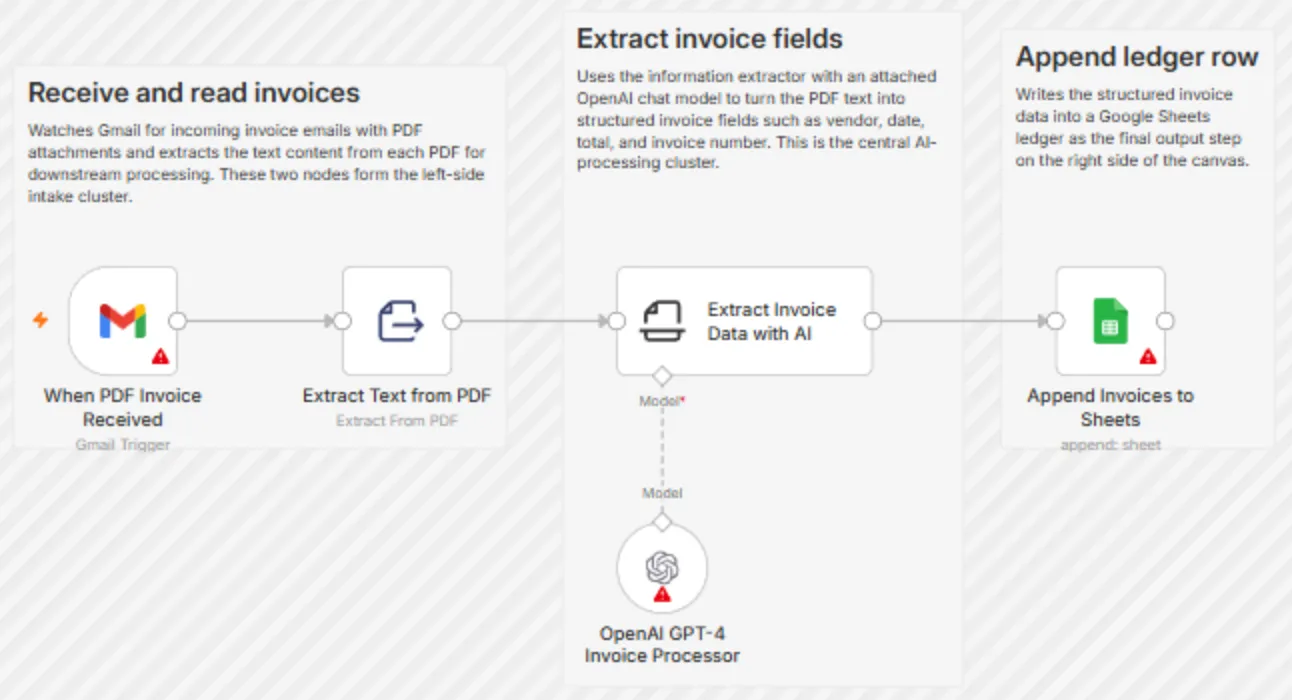
- 1 Gmail: an email with a PDF invoice arrives
- 2 Text is extracted from the PDF
- 3 The AI model pulls out the supplier, date, amount and invoice number
- 4 The data is written to a spreadsheet
- Content and marketing workflows. AI generates first drafts of emails by segment (a new wave of leads, existing customers, overdue invoices), writes social media posts following your brand voice guidelines, and prepares product descriptions for an online store from a short technical specification. The marketing lead only edits and approves instead of writing from scratch.
For a content team this can save a few hours a week, and AI-generated A/B variants make it possible to test more often and improve campaign results. Practical Lithuanian examples and tools: (Social media content automation).
- Internal report synthesis and P&L reviews. Once a week or once a month, AI collects data from Pipedrive, Google Analytics, Centas and the bank's PSD2 API and builds a management summary with the key metrics (revenue, margin, number of new customers, deal size, reasons for lost deals). It adds a short narrative comment, for example "18% more leads this week than last, but conversion fell by 4%; probably because of the quality of the new Facebook campaign".
The owner opens the email on Monday morning and sees the state of the business in 5 minutes, not after two hours of manually compiling Excel. Specific tools and templates are described in this article (Automated business reports).
How do you choose a starting scenario? A 3-criteria model
A common mistake among Lithuanian SMBs is to start with the "trendiest" scenario rather than the one that will actually deliver results. A simple 3-criteria model helps, and you can fill it in on your own. If you send it to me, I will reply with the scenario I would start with.
Criterion 1: ROI clarity. Is there a manual process right now whose saved time can be measured in specific hours and an hourly rate? If so, you can answer "how many months until it pays back?" before you start. If the process is about a "better customer experience" without numbers, put it off until you have a metric you can compare before and after.
Criterion 2: data availability. Is the data the AI scenario needs already in a structured system with an API (CRM, accounting, bank PSD2)? If so, setup takes 3–5 weeks. If the data is scattered across Excel files and emails, clean up your data hygiene first, and only then add AI.
Criterion 3: cost of change management. How many employees will have to change their daily routine? The first scenario should affect 1–3 people, not the whole team. Starting in a narrow area makes it easier to train people, collect feedback and adjust before expanding. A broad transformation of the "everyone switches to AI within a quarter" kind almost always falls flat.
Three most common mistakes to avoid
Mistake #1: starting with the tool, not the problem. "Let's buy ChatGPT Enterprise" or "let's roll out Microsoft Copilot" is an answer to a question you have not asked yet. First identify a specific pain point with hours and costs; only then choose the tool that solves it. For most Lithuanian SMB scenarios, a combination of n8n + the OpenAI/Claude API is enough. It costs €15–40 a month, not a €30 per user per month fee for a platform you have not yet tested.
Mistake #2: automating a chaotic process. If your manual CRM data entry is messy (duplicates, unclear categories, half-complete information), AI-automated chaos will happen a thousand times faster and with a thousand errors. First fix the data model, standardize the categories and clean up the duplicates, then add the AI layer.
Mistake #3: forgetting about maintenance. AI model API prices change, integrations break after platform updates, and the system prompt needs fixing after new edge cases. Companies that deploy AI as a one-off project without 1–2 hours a month of maintenance often go back to manual work after a few months, because the workflow quietly stopped and nobody noticed.
AI for business FAQ
How much does an AI solution cost for a Lithuanian SMB? An indicative ladder for 2026: a one-off n8n workflow with an AI classifier costs €450–1,200; a full package of 4–5 scenarios with integrations costs €2,500–6,000; monthly maintenance costs €150–300 a month. The variable monthly cost (OpenAI/Claude API + n8n + Document AI) for a typical Lithuanian SMB is €15–60 a month. More on prices in this article (How much does AI automation cost for a small business?).
Is AI for business worth it for small teams of 3–10 people? It is, if there is at least one recurring process that happens 5+ times a week and takes 5+ minutes each time. For small teams AI often has a relatively bigger impact than for large ones, because one saved hour of work means much more in percentage terms.
How should you start: on your own or with a partner? If someone on the team has a technical background (n8n, APIs, a bit of Python or JavaScript) and 20–40 free hours, you can start on your own. If you want a solid start with lower risk, a partner sets it up in 4–6 weeks, and you get a working workflow and documentation the team can use to keep expanding on its own.
What are the risks of using AI in business? There are three main ones. First, data privacy: make sure personal data goes through service providers in EU regions (for example, Claude through AWS Bedrock or Google Cloud Vertex AI EU regions, OpenAI models through Azure EU regions, n8n self-hosted in an EU data center) and that a DPA is signed. Second, hallucinations: AI can make up facts, so in sensitive scenarios (finance, law, health) always keep a human approval step before the result is sent. Third, dependence on one vendor: design workflows so that OpenAI can be replaced with Claude in a single configuration step.
Is AI suitable for a very small business (1–3 people)? Yes, but with a narrower scope. A team of 1–3 people usually needs only one AI scenario, for example an email classifier that sorts incoming enquiries into "reply today", "reply this week" and "spam/automated". The investment is €450–800 one-off + €10–25 a month. It often pays back within a few months if you get 10+ emails a day on average.
Next steps
If you are considering your first artificial intelligence project for your business in Lithuania, I recommend starting in three steps: (1) within 1 week, pick one specific pain point that fits the 3-criteria model and, if you want a second opinion, describe it to me in a message; (2) over 2–4 weeks, set up the first narrow scenario (usually a CRM classifier or a chatbot) and measure the time saved; (3) after the first working month, expand to a second and third scenario from the list of five use cases above.
Aigentas helps Lithuanian SMBs build an AI layer on top of their existing systems (CRM, accounting, online store, bank PSD2) using the n8n integration platform with OpenAI and Claude models. A demo before the contract: no advance payment until you see a working solution on your real data. Write to me (free consultation) about which tasks take up the most of your team's time. I will read it and reply by email where AI would make the most sense. If questions remain, we will arrange a call; we agree on the scope and price of paid work before starting.