In short: automated dropshipping is a store (Shopify, WooCommerce or another platform) that pulls in the supplier's products, prices and stock by itself, passes each order to the supplier right away, sends the tracking number back to the customer and issues the invoice. People are left with choosing suppliers, marketing and exceptions. Automation cuts the work, but it does not make the business profitable: margin, supplier and delivery time decide that.
I checked prices and tax rules on October 17, 2026 (VMI, the European Commission, tool vendors' websites). The tax information is general; discuss your own case with your accountant.
What is automated dropshipping? The short answer
In the dropshipping model you have no warehouse: the customer buys in your store and the supplier ships the goods. Done by hand, that means constant retyping: supplier prices and stock change, every order has to be forwarded, the tracking number copied, the invoice issued. At 5 orders a day it is annoying; at 50 it becomes impossible to do without mistakes. Automation joins these steps into a single workflow.
- 1Supplier products, prices and stockXML · CSV · API · DSers / Syncee
- 2The customer pays for the orderShopify · WooCommerce
- 3The order is passed to the supplierAPI · app · email with a CSV
- 4The tracking number comes back, the customer gets an emailOmniva · LP Express · DPD
- 5The invoice is issuedInvoicing software APIPeople are left with suppliers, marketing and exceptions.
This article is for beginners and for those already selling in Lithuania: how to connect a supplier to your store technically, which tax rules not to forget and where automation will not help. For the bigger picture of e-commerce automation, see e-commerce automation.
Which dropshipping processes can you automate?
| Process | By hand | Automated |
|---|---|---|
| Product import | Descriptions and images are copied | The supplier's XML, CSV or API is loaded by product code (SKU / EAN) |
| Prices | Recalculated in a spreadsheet | Markup rules by category, minimum margin, rounding |
| Stock | Checked on the supplier's website | Updated several times a day, sold-out products are hidden |
| Order handoff | An email to the supplier or an order on their website | The order goes via API, an app or an automatic email with a CSV |
| Tracking number | Copied from the supplier's email | Comes back to the store, the customer gets an email |
| Invoices | Issued by hand | Created via the invoicing software API once the order is paid |
| Supplier invoices | Entered by the bookkeeper | OCR scanning and handoff to the accounting software |
| “Where is my parcel?” questions | Answered by hand | A tracking page, an AI assistant with the order data |
How do you sync supplier products, prices and stock?
There are two routes, and the supplier decides which one you take.
- The supplier has an app (AliExpress via DSers, Syncee, BigBuy and others). You install a Shopify or WooCommerce app, pick products, set markup rules, and the app does the syncing. It is fast, but you depend on the app's limits and prices.
- The supplier provides a data file or an API: this is how most Lithuanian and other EU wholesalers work. A workflow (n8n, Make or a WooCommerce import plugin) downloads the file on a schedule, matches products by SKU or EAN, applies the pricing rules and updates only the agreed fields.
Practical rules that save a lot of stress:
- Before you buy a store, ask the supplier for a sample data file: does it have EANs, images, weights, descriptions in Lithuanian?
- Update stock at least 2–4 times a day; for popular products set a safety stock (for example, show “out of stock” when the supplier has fewer than 3 units).
- Build shipping, payment fees and VAT into the pricing rule, not just the supplier's price.
- Do not overwrite what you edited by hand: your unique descriptions must stay when prices are updated.
- Rewrite the texts for your best-selling products and categories first: the same supplier description in ten stores does not help you on Google.
How do you route orders to suppliers automatically?
Once an order is paid, the workflow does the following:
- Check. Has the payment really arrived, is the address complete, does the order look like fraud (a different country, an unusually large amount)?
- Split by supplier. If the cart has products from two suppliers, the order is split and the customer is told they will receive two parcels.
- Handoff. Via the supplier's API, an app or an automatic email with the order data. If the supplier only works through their own website, that is the weak spot worth discussing with them.
- Waiting for confirmation. If the supplier has not confirmed within a set time (for example, 24 hours), you get a notification in Slack, Teams or by email.
- Cancellations. When the supplier reports that a product is gone, the customer gets an offer (an alternative or a refund) and the product is hidden straight away.
An example (illustrative): a Lithuanian store sells products from two EU wholesalers. One accepts orders via API, the other only by email. The n8n workflow places the order via API with the first one, and for the second it sends an email with a CSV file every hour and checks for the reply. In both cases the store owner only steps in when something fails.
Tracking numbers and emails to customers
The most common customer question in dropshipping is “where is my parcel?”. Three things cut it down: the supplier's tracking number goes back into the order automatically (Shopify calls this “fulfillment”), the customer immediately gets an email with a link to the carrier's tracking (Omniva, LP Express, DPD, Venipak or an international carrier), and if the parcel has not moved within the expected time, you get an alert before the customer writes to you.
Be honest in your emails that the product ships from the supplier's warehouse, and give the real delivery time. From a consumer rights point of view, delivery information has to be given before the purchase, not only after it. How automatic text messages and emails to customers work is described in automatic notifications for customers.
Dropshipping VAT, OSS and customs: what you need to know in Lithuania
The key point: in its commentary on the OSS scheme (in Lithuanian), VMI covers dropshipping separately and states that the seller, even though they do not ship the goods themselves, is treated as the actual seller of the goods and is responsible for paying the VAT. The other main reference points in October 2026:
| Situation | Rule |
|---|---|
| VAT registration in Lithuania | Mandatory when the consideration from VAT-taxable activity in Lithuania exceeds €45,000 in the current or previous calendar year (rule in force since May 1, 2025). For legal entities, also when goods acquired from other EU countries exceed €14,000. |
| Sales to consumers in other EU countries | When your total EU distance sales exceed €10,000 a year, VAT is charged at the buyer's country rate. Instead of registering in each country, you declare through OSS in Lithuania every quarter. |
| Goods from non-EU countries in parcels up to €150 | Import VAT applies from the first euro; the IOSS scheme lets you collect VAT at checkout so the customer does not have to pay at customs. |
| Customs duty on low-value parcels | Since July 1, 2026 the EU charges a temporary €3 customs duty per type of goods (tariff heading) in parcels up to €150; it is planned to apply until the full customs reform in 2028. |
| A supplier in another EU country ships directly to the customer | This is a chain transaction; where and who pays VAT depends on who arranges the transport. Be sure to discuss it with your accountant before you start. |
Sources: VMI: when to register for VAT, VMI OSS system, European Commission on the €3 customs duty. Automation helps here in a practical way: the store applies the correct VAT rate based on the buyer's country, and at the end of the quarter the workflow prepares the summary by country and rate that you need for the OSS return.
How do you automate invoices and bookkeeping?
- Sales document. Once the order is paid, an invoice or VAT invoice is created via the invoicing software API (for a business buyer, with a VAT number checked in the VIES system) and sent together with the order confirmation.
- Supplier invoices. Incoming invoices are read from email automatically (OCR), matched to orders and passed to the accounting software.
- Returns. When money is refunded, a credit note is created automatically.
- Profit report. For each order: sale price − supplier price − shipping − payment fee − advertising. That way you can see which products really make money.
Which Lithuanian invoicing apps have an API and Shopify or WooCommerce connectors, I compared in invoicing software 2026, and scanning incoming invoices in the cost of invoice automation.
Dropshipping automation tools: comparison and prices (October 2026)
| Tool | What it does | Price | Best for |
|---|---|---|---|
| DSers | Official AliExpress partner: product import, bulk order placement, price and stock updates | Basic free; Advanced $19.90/month; Pro $49.90/month | Shopify / WooCommerce with AliExpress suppliers |
| Syncee | Supplier marketplace (many EU and US brands), automatic forwarding of orders and tracking numbers | Basic $39.99/month (100 products), Pro $59.99/month (250 products), $99.99/month (10,000 products) | When you need EU suppliers and faster delivery |
| BigBuy | Spanish wholesaler with an EU warehouse, a catalog and connectors for stores and marketplaces | Per third-party sources ~€69/month (Ecommerce Pack) + €90 activation; connectors extra | Wide catalog, goods from an EU warehouse |
| AutoDS | Product import, price monitoring, automatic order placement with suppliers | Plans by number of products; automatic order fulfillment add-on $9.90/month | Several suppliers and platforms in one place |
| Supplier XML / CSV / API + n8n or Make | Your own workflow: import, markups, stock, order handoff by email or API, tracking numbers | Setup from €450, n8n server ~€10–25/month | Lithuanian and EU wholesalers that have no Shopify app |
DSers, Syncee and AutoDS prices come from the vendors' websites (monthly billing, excluding VAT); BigBuy shows its official price only after you register, so I give figures from third-party sources. I am not affiliated with any of these suppliers.
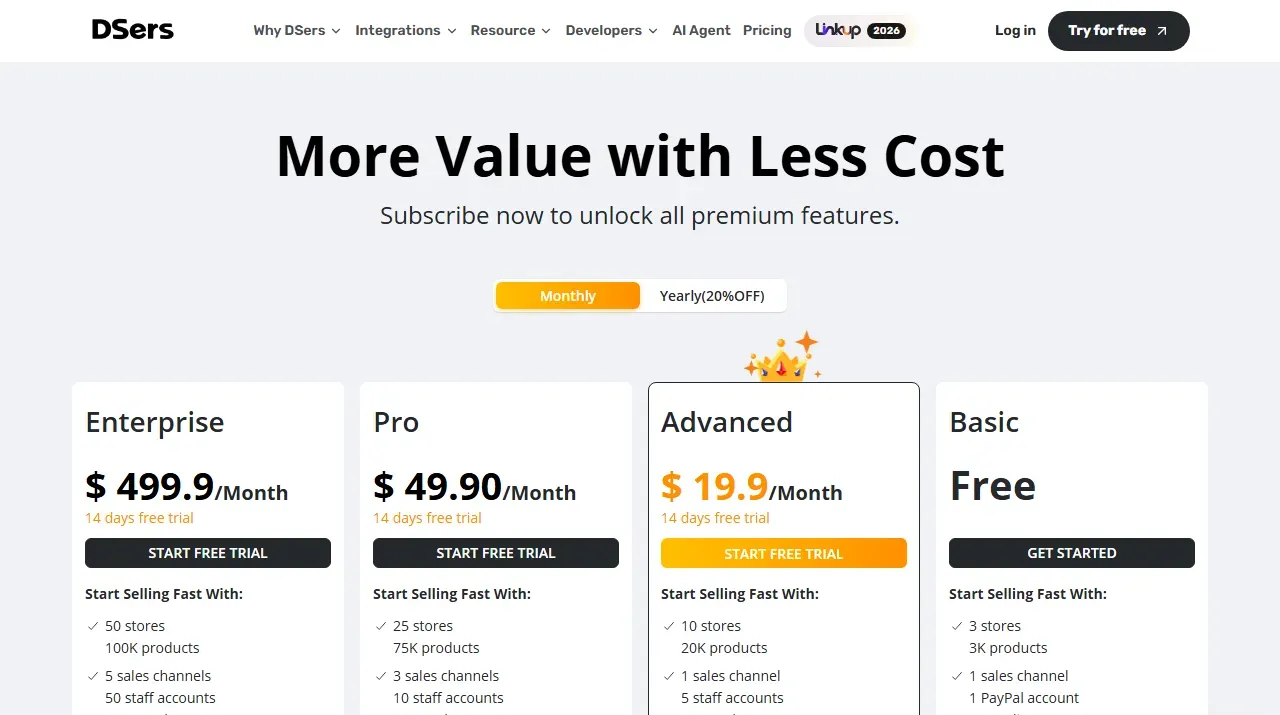
- 1 Basic: free, up to 3 stores
- 2 Advanced: $19.9/month
- 3 Pro: $49.90/month
When should you choose an app, and when a custom workflow? If you work with AliExpress or Syncee suppliers, an app is usually enough. A custom workflow pays off when your supplier is a Lithuanian or EU wholesaler with an XML file, when you have several suppliers, when invoices have to reach Lithuanian accounting software, or when you also sell on marketplaces (Pigu.lt, Varle.lt). I set up such a workflow from €450 in 1–2 weeks; more on automation for e-commerce and the pricing page.
To be honest: the risks automation does not solve
- Thin margins. The 10–25% gap between the supplier's price and yours still has to cover shipping, payment fees, advertising and returns. Automation saves time, but it does not create margin.
- Responsibility to the buyer. The 14-day right of withdrawal and the quality guarantee apply to you, even if the supplier does not accept returns.
- Product safety. Since December 13, 2024 the EU General Product Safety Regulation (GPSR) applies: the product page must show the manufacturer and the person responsible for safety in the EU, plus warnings. Cheap non-EU products without labeling are a risk.
- The supplier's mistakes become your mistakes. Outdated stock, prices changed without notice, lost parcels. Good syncing reduces this risk but does not remove it.
- Payment and ad accounts. Many complaints about late parcels can end with your payment provider freezing funds or your ad account being restricted.
- Competing with the same catalog. If ten stores import the same supplier file, the winner is not decided by automation but by the niche, content and service.
If you are planning to dropship, start with one niche and one reliable EU supplier, and automate once there is an actual flow of orders. Send me what data your supplier provides: I will review it and reply by email with what is worth handing to a system first.
Frequently asked questions
Is dropshipping legal in Lithuania?
Yes. It is ordinary distance selling; the only difference is that the supplier ships the goods to the customer. You need a registered business (individual activity, a small partnership (MB) or a private limited company (UAB)), terms of sale, a privacy policy and bookkeeping. VMI (the Lithuanian tax authority) explains that in dropshipping you are treated as the actual seller: you are responsible for the transaction, customer service and VAT.
What can you automate in dropshipping?
Almost all of the operations: importing products and images, pricing based on markup rules, updating stock several times a day, passing the order to the supplier, sending the tracking number back to the store with an email to the customer, issuing invoices, entering supplier invoices and the profit report. What you cannot automate: choosing suppliers, niche decisions and complicated returns.
When do you have to register for VAT?
Since May 1, 2025, registration in Lithuania is mandatory when the consideration from VAT-taxable activity in Lithuania exceeds €45,000 in the current or previous calendar year. When you sell to consumers in other EU countries and those sales exceed €10,000 a year, VAT is charged at the buyer’s country rate; the OSS scheme is the most convenient way to handle that.
Is dropshipping from China still worth it in 2026?
Less and less for the Lithuanian market. Since July 2021, import VAT applies to low-value parcels too, and since July 1, 2026 the EU charges a temporary €3 customs duty per type of goods in parcels up to €150. Add 2–4 weeks of delivery and expensive returns: EU suppliers are usually the safer choice.
Who is responsible if the product is defective?
You are responsible to the buyer, not the supplier. A consumer has a 14-day right to withdraw from a distance contract and the right to a quality guarantee. So it pays to spell out the returns and defects procedure in your contract with the supplier, and to log return requests in your automated workflow.
How much does dropshipping automation cost?
Off-the-shelf apps cost from $0 to $60–100 a month. A custom workflow with a Lithuanian or EU supplier’s XML or API, order routing, tracking emails and invoices costs from €450 one-off and is usually set up in 1–2 weeks.