The owner of an online store in Vilnius opens his email in the morning: 14 new messages. One customer asks whether their order has shipped. Another wants to know if an item fits their size. A third is writing about a return. A fourth is annoyed that nobody replied within three hours last night. On top of that, there are abandoned carts to deal with, stock to monitor and product recommendations to write. This kind of daily routine eats into profit faster than any marketing spend.
An AI agent for an online store changes this fundamentally. Unlike simple chatbots or standard automated emails, an AI agent can analyze, decide and act on its own: it checks order status in real time, analyzes browsing history and gives personalized recommendations, follows up on abandoned carts with the right message, handles return requests and predicts which products will run out soon. All of this runs 24 hours a day, 7 days a week, with no extra labor costs.
This article is for online store owners with an annual turnover of €50,000–500,000 who are starting to feel that manual work is holding back growth. I start with six steps to automate customer service, then cover five AI agent functions, integration with Shopify and WooCommerce, a typical store example and an honest ROI calculation.
How to automate customer service in an online store: 6 steps
Short answer: start automating customer service in your online store with the most common questions. Collect 20–30 recurring questions with answers, connect a chatbot or AI agent to your order and shipping data so it can answer "where is my parcel?", automate order status notifications and return intake, and set clear rules for when a conversation is handed to a person.
- Count your enquiries.Go through last month's emails and chats and group them: order status, delivery, returns, product questions, invoices. In most stores a few groups make up the bulk of all enquiries, and that is where you start.
- Write a knowledge base.Delivery times and prices (Omniva, LP Express, DPD), return conditions, size charts, payment methods. Without it, no automation will answer correctly.
- Automate notifications so customers ask less.Order confirmation, a shipping email with a tracking link and a notice when the parcel reaches the parcel locker. Every well-timed notification is one less "where is my order?" email.
- Connect the chatbot or AI agent to your order data.A bot that only answers from an FAQ cannot answer "where is my parcel?". Through the Shopify or WooCommerce API, the agent checks the status and tracking number by order number or email.
- Automate returns.The agent checks whether the 14-day withdrawal period is still valid (or a longer one, if you have set it), logs the request and sends the instructions. Leave the refund decision to a person.
- Set up handover to a person.Complaints, damaged items, discount requests and angry customers go to an employee with a conversation summary. From August 2, 2026, Article 50 of the EU AI Act requires you to inform customers that they are interacting with an AI system (unless this is obvious from the context).
What gets automated and what stays with a person
| Enquiry | Who answers | Where the answer comes from |
|---|---|---|
| "Where is my parcel?" | Automatically | Order status and courier tracking |
| Delivery price and times | Automatically | Knowledge base |
| Is the item in stock, which size fits | Automatically | Stock levels, size chart |
| Return or exchange | Agent prepares, a person approves | Order, return rules |
| Invoice for a company | Agent prepares, a person approves | Order, accounting software |
| Complaint, damaged item, discount | A person | Agent provides a summary and order data |
Which tools are used
There are three routes. Platform tools (e.g. Shopify Inbox, WooCommerce email settings): a free start, but limited capabilities. Help desk and chat platforms (Tidio, Smartsupp, Gorgias, Zendesk): a ready-made chat window and ticket inbox, priced by the number of conversations or agents. A custom AI agent (n8n or Make with an OpenAI or Claude model): when you need to connect to Lithuanian systems (Omniva, LP Express, Paysera, B1, Rivile (a Lithuanian accounting system)) and answer by your own rules. More scenarios in 7 automated customer service scenarios; on chatbots, see AI chatbot for your website.
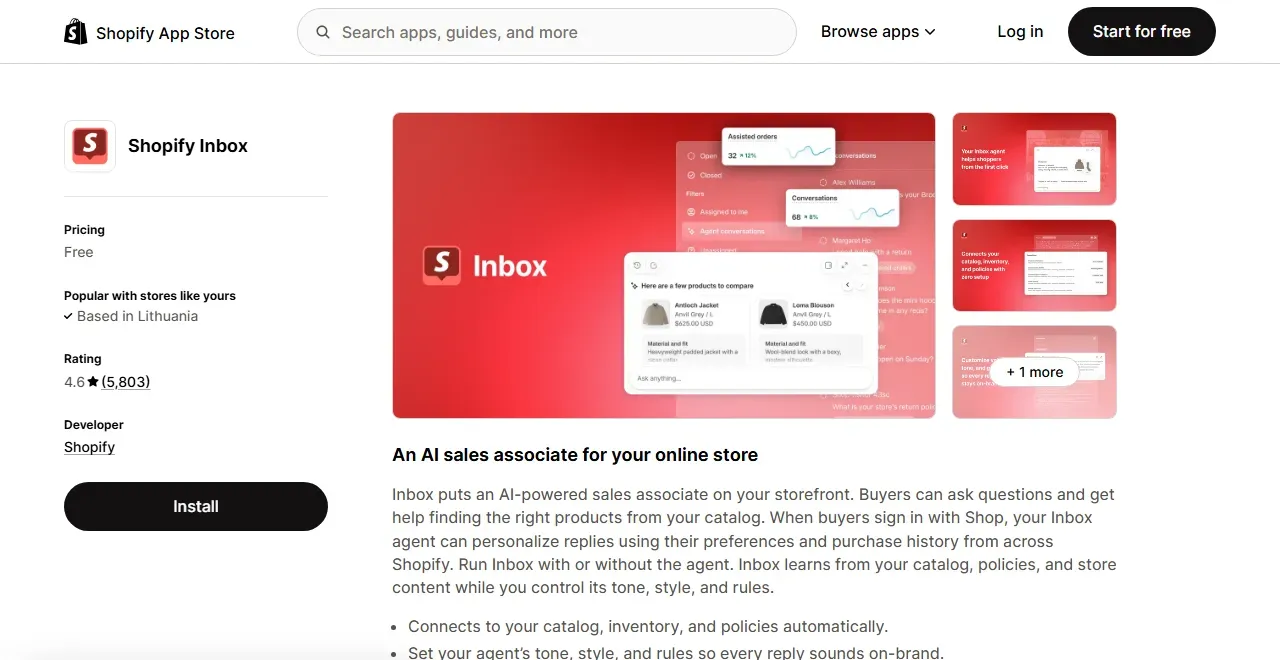
- 1 Pricing: Free: the app costs nothing
- 2 Connects to your catalog, stock levels and store policies
Why online stores need an AI agent in 2026
Three problems that push online store owners to look for an AI solution come up again and again in conversations with them. They are not new, but in 2026 solutions that used to be out of reach have become affordable for small stores too.
Response time decides the purchase. A shopper who is unsure about a size or delivery rarely waits until morning for an answer. Yet many Lithuanian stores serve customers from 9 a.m. to 6 p.m., while a large share of shopping happens in the evening and on weekends. Every question left unanswered after hours is a potentially lost sale.
Abandoned carts eat into profit. According to the Baymard Institute (an average of 50 studies, updated in 2025), about 70% of online shopping carts are abandoned (Baymard Institute). Some of those shoppers are simply hesitating and waiting for an extra nudge: a discount code, an answer about delivery, confirmation that the item fits. An AI agent can recognize this behavior and respond automatically at the right time with the right message.
Night and weekend load keeps growing. In many stores, evenings and weekends are peak buying time. Shopper activity often peaks exactly when no one is on duty. An AI agent removes this problem: customer service runs around the clock with no extra labor costs.
5 AI agent functions in an online store
Not all AI agents are the same. The functions below are not a theoretical list of possibilities but what can realistically be set up in a Lithuanian store and can deliver a measurable result.
1. Order status enquiries 24/7
In most online stores the single largest group of enquiries is "Where is my order?". This question takes up a lot of time, yet the answer is always found the same way: check the system and read the tracking number.
The AI agent integrates directly with the WooCommerce or Shopify database and with the LP Express and Omniva parcel tracking systems. A customer writes "Where is my order No. 12345?" and within seconds the agent returns the exact status with a tracking link and the estimated delivery time. The answer comes at midnight, on a weekend, on a public holiday: always. The AI agent can also proactively tell the customer about shipping stages: when the parcel is dispatched, reaches Lithuania or goes out for delivery. This keeps customer-initiated enquiries to a minimum.
- 1The customer writes the order numberChat window · email
- 2The agent finds the orderShopify · WooCommerce API
- 3Checks the parcel statusLP Express · Omniva
- 4The customer gets an instant reply with a tracking linkComplaints and unusual cases go to an employee with a summary.
2. Product recommendations based on browsing history
Personalization is one of the most effective conversion tools in e-commerce. But tracking every customer's browsing history by hand and suggesting the right products is simply impossible.
The AI agent analyzes what the customer viewed, added to the cart and bought before, and gives recommendations in real time. "You viewed these running shoes; customers who bought this model also like these socks and this running belt." Integration with the WooCommerce product catalog and sales history lets the AI agent learn: the more data, the more accurate the recommendations.
3. Abandoned cart follow-up with personalized emails
Recovering abandoned carts is one of the biggest revenue opportunities in e-commerce. Typically, a store sends everyone the same "Forgot something?" email. It works, but the results are average.
An AI agent does it differently: it analyzes why the shopper left the cart (delivery too expensive? unsure about the size? comparing with competitors?) and sends a personalized email with the right solution. If the cart has clothing, it offers help with sizing. If the delivery cost was high, it offers free delivery above a certain amount. If the customer has bought before, it sends an exclusive loyalty discount. Emails like these usually work better than one generic reminder for everyone, but the effect is worth measuring in your own store.
4. Managing returns and exchanges
Returns are one of the most time-consuming processes in e-commerce. A customer writes that they want to return an item. An employee has to explain the procedure, send a return form, check the order, confirm the return is possible and decide on the refund. A case like this often takes 10–15 minutes.
The AI agent automates this whole flow: it takes the return request, checks the order data (date, item, purchase amount), explains the return policy and sends return instructions with an LP Express or Omniva label. More complex cases (a damaged item, not as described, the return period has passed) go to an employee with the full conversation context, so they can decide without asking further questions.
5. Forecasting stock levels
Stores selling physical goods often face two opposite problems: a popular item sells out unexpectedly, or they hold large amounts of slow-moving stock that ages in the warehouse.
The AI agent analyzes sales history, seasonal patterns and current stock levels, and predicts when each product will run out. The manager gets an automatic alert when stock drops to a critical level. More advanced versions can automatically create a purchase order for the supplier or pause sales of the item on the website until stock is replenished. This scenario is especially useful for seasonal products and promotional periods, when stock management mistakes are costly.
How an AI agent integrates with Shopify and WooCommerce
Technically, an AI agent is integrated into a Shopify or WooCommerce store through API connections. The store owner does not need to understand programming, but it helps to know the basic principles.
Shopify has a well-documented API that gives the AI agent access to all the information it needs: order status, stock levels, customer profiles and browsing history. WooCommerce also has a REST API, although in some cases you may need extra WordPress plugins for specific functions.
The AI agent is deployed on two levels: as a visible chat window on the store website (usually in the bottom right corner) and as background processes that watch the data and trigger actions automatically (abandoned cart emails, stock alerts, proactive shipping notifications) without any customer or employee involvement.
An important nuance: an AI agent working in Lithuanian e-commerce has to be set up for the Lithuanian language and local business specifics: Omniva and LP Express integration, Lithuanian date and currency formats, GDPR requirements for storing customer data. A standard global chatbot does not meet these requirements.
Example: a store dealing with night-time enquiries
For example, a food supplement store with an annual turnover of about €200,000 and three employees faces a typical problem: on weekends and in the evenings customers send questions but wait for answers until Monday or the next morning. In the meantime, some of them buy elsewhere. The three employees have to split their time between operational work and monotonous repeat questions.
In a case like this, an AI agent is set up with three core functions: checking order status, automatic answers to the most common questions (returns, delivery times, product ingredients) and abandoned cart follow-up with personalized emails.
What to expect: repeat questions about orders and delivery are answered instantly, at night too, and in the morning the staff find only the conversations that need a human decision. Exactly how much the workload drops depends on the mix of your enquiries; I assess this during an audit by counting last month's enquiries. This is an illustrative example, not a specific client case.
Setup cost and ROI calculation
The cost of setting up an AI agent for an online store depends on the scope of the project and the number of systems to integrate.
Basic solution (a chat window on the website with answers to the most common questions and order status checks): from €450 one-time. Mid-level solution with abandoned cart automation, returns management and product recommendations: €1,000–2,000. Full solution with stock forecasting, multilingual support and an AI learning module: €2,000–4,000. Support and optimization: from €150/month extra.
ROI calculation: if the AI agent saves employees 2 hours a day (roughly €12–15 per employee hour), that is about €500–650/month saved in labor costs alone. On this calculation alone, a basic solution at €450 pays for itself in the first month; recovered carts and faster replies are an additional benefit that should be measured separately.
Want to know what ROI is realistic for your store? Write to me with how many orders and customer questions you get a month and your abandoned cart rate, and I will read it and email you an indicative calculation. If anything needs clarifying, we will arrange a call. More about the services: AI agent development for online stores and e-commerce automation.