In short: the most popular business management system in Lithuania is Rivile: according to the 2025 study by RAIT and Informacinės konsultacijos, 21% of the companies surveyed use it. Microsoft Dynamics NAV, Agnum and Dynamics 365 Business Central are also common, while small companies are often fine with Site.pro or Rivile ERP in the cloud (€7–25 per month). For trading companies, the warehouse module and an API matter most, so stock levels and orders move automatically.
I checked the prices on the vendors' and resellers' websites on October 17, 2026. Prices exclude VAT and may change, so check before you decide. I am not affiliated with these vendors: I do not sell or implement ERP systems myself; I connect them with other software.
What are the most popular ERP systems in Lithuania?
The latest data comes from the 2025 study by RAIT and Informacinės konsultacijos, repeated after a 9-year break. According to it, four systems are used most often: Rivile, Microsoft Dynamics NAV (Navision), Agnum and Microsoft Dynamics 365 Business Central. Rivile is used by 21% of the companies surveyed; no other system reached 8% (BNS press center, October 2025; the study was carried out in March 2025 and surveyed 191 companies). According to the authors, companies often choose a system out of habit rather than after analyzing the market.
Keep in mind that Dynamics NAV is the older version of Business Central: for new projects Microsoft offers Business Central in the cloud, and NAV users are gradually migrating. So in practice the choice today is between Lithuanian systems (Rivile, Agnum, Labbis, Finvalda, Pragma, Stekas, Site.pro), Directo, which is popular across the Baltics, and international ones (Business Central, Odoo, SAP Business One).
10 ERP systems compared: prices, warehouse, API (October 2026)
| System | Price excl. VAT | Inventory / warehouse | API and integrations | Best for |
|---|---|---|---|---|
| Rivile ERP (cloud) Lithuania | Mini from €19 per user/month, Standard from €25 | Warehouse, purchasing, sales | Yes (Rivile API) | Small and mid-sized trading and service companies |
| Rivile GAMA Lithuania | Rental €45 (GAMA-1) or €59 (GAMA-2) per workstation/month | Inventory, bin locations, MSCAN scanning (€25/month) | REST API, from €18/month for higher volumes | Trading, manufacturing, companies with several warehouses |
| Directo Estonia | €199/month (3 workstations) or €499/month with manufacturing (5 workstations) | Warehouse, DPD and Itella shipments | XML via webservice, €25/month per document type | Growing trading and service companies in the Baltics |
| Finvalda Lithuania | WEB €15/month; MINI €299, MIDI €995 (or rental from €35/month) | Warehouses, cash registers, e-commerce (MIDI, MAXI) | Integrations on request | Accounting firms, trading, several legal entities |
| Agnum Lithuania | Custom quote | Inventory accounting, barcodes, packaging | API, XLS / XML import, i.SAF, i.VAZ, GPAIS | Wholesale and retail, manufacturing |
| Labbis (KONTO, LOGAS) Lithuania | From €43.20/month; KONTO rental from €81/month | Purchasing, sales, warehouse | On request | Companies for which HR and payroll matter |
| Stekas Lithuania | Licenses through resellers, price depends on the bundle | Inventory accounting program in the bundle | — | Public sector bodies, traditional accounting |
| Site.pro (formerly B1.lt) Lithuania | €7 per company/month + user plan, excl. VAT | Stock sync with Shopify, Amazon, Pigu.lt, Varle.lt and others | Yes, API and MCP | E-commerce, small partnerships (MB) and small companies |
| Odoo Belgium | One app free; Standard from USD 24.90 per user/month | Inventory module, Barcode app | External API only on the Custom plan | Companies that want CRM, online store and warehouse in one system |
| Microsoft Dynamics 365 Business Central USA | Essentials £61.50, Premium £84.60 per user/month (UK price list); euro prices through a partner | Inventory, warehouse management, supply planning | Yes, standard APIs | Mid-sized companies, groups, Microsoft 365 users |
“—” means I found no public information. Pragma is another widely used Lithuanian system, but I found no public price list on its website, so it is not in the table. Microsoft publishes Business Central prices in pounds and dollars; a Lithuanian partner gives the euro price together with an implementation quote.
What to know about each ERP system
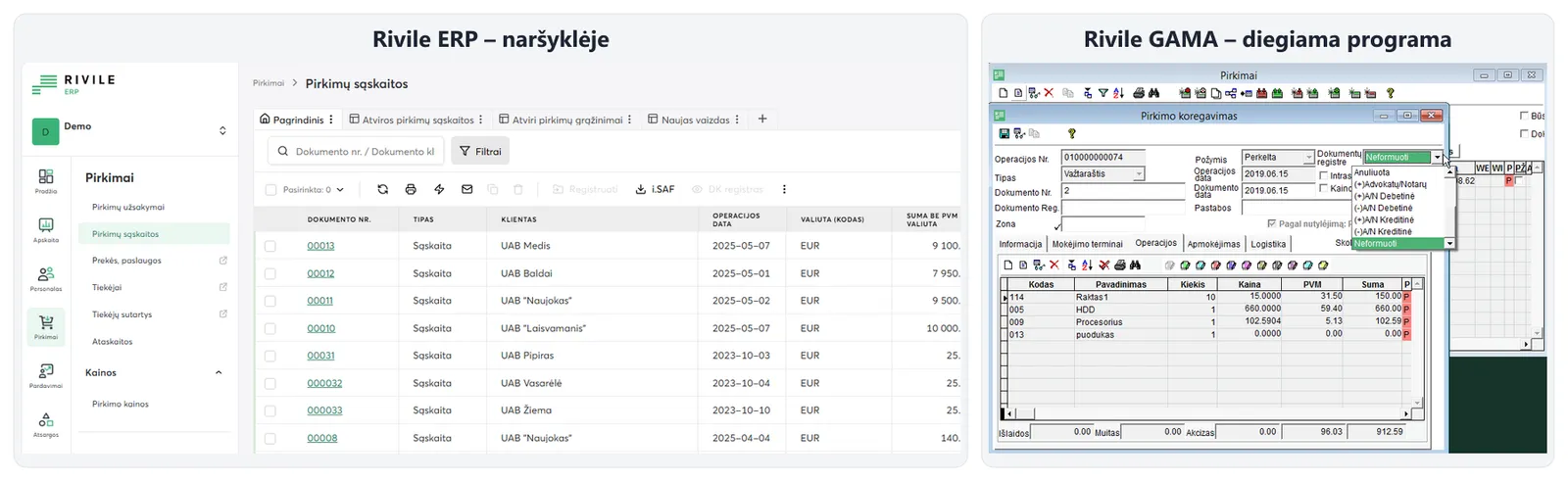
Rivile. Two different systems: Rivile ERP, a browser-based cloud version priced per user per month, and Rivile GAMA, an installed system with modules (warehouse, manufacturing, payroll, POS, EDI). The GAMA-1 rental package costs €45, and GAMA-2 with payroll and i.SAF-T (the Lithuanian SAF-T tax file) costs €59 per workstation per month. A big advantage is that many accountants know it, and the Rivile API lets you connect an online store or CRM.
Directo. An Estonian cloud system that is growing in Lithuania among trading and service companies. The pricing is transparent: the base package is €199 per month for three concurrent users (without manufacturing and payroll), €499 with manufacturing, and each additional user is €49. It has ready connections to DPD, Itella, Swedbank Gateway, i.SAF, i.VAZ and SABIS (the public sector e-invoicing system), and data exchange with other systems runs through an XML webservice (€25 per month per document type).
Finvalda. A Lithuanian system with several tiers: the browser version Finvalda WEB from €15 per month, the MINI license at €299, and the most popular MIDI at €995 or rental from €35 per month. The license covers 10–15 companies, which is why accounting firms like it.
Agnum. A strong inventory and trading system: barcode scanners, packaging accounting, point of sale, manufacturing, Intrastat. It runs locally, on a terminal server or in the cloud (SaaS). Pricing is by quote.
Labbis. Separate systems for accounting (KONTO, LOGAS) and HR (BONUS). The vendor lists prices from €43.20 per month, KONTO standard rental from €81 per month, and licenses at €550–660.
Site.pro (formerly B1.lt). The cheapest full accounting option: €7 per company per month plus a user plan. For e-commerce, the key feature is syncing orders, customers, invoices and stock with Shopify, Amazon, Etsy, eBay, Allegro, Pigu.lt and Varle.lt. It has an API and an MCP interface for AI agents.
Odoo. A system built on open source with CRM, online store, warehouse, manufacturing and accounting in one place. One app (for example, CRM only) is free for unlimited users; all apps are on the Standard plan from USD 24.90 per user per month (odoo.com shows the price by region, with a first-year discount). An important detail: according to Odoo's price list, the external API is only on the Custom plan, and Lithuanian accounting (i.SAF, SAF-T) usually requires modules from a local partner.
Microsoft Dynamics 365 Business Central. The cloud successor to NAV. Microsoft's official UK price list in October 2026: Essentials £61.50, Premium (with manufacturing and service) £84.60 per user per month, and limited-rights Team Members £6.20. Copilot and AI agents (for example, a sales order agent) are included, but using them requires separately purchased Copilot credits (Microsoft price list). Lithuanian localization and implementation are done by partners.
Stekas and Pragma. Long-standing Lithuanian systems with loyal users. Stekas licenses are sold through resellers in bundles (for example, LITS lists a “STEKAS apskaita” bundle for public sector bodies at €600 excl. VAT); Pragma prices by quote.
Inventory management tools: what is new in the Lithuanian market in 2026?
If you are looking for the newest inventory management tools, the biggest changes are happening not in the warehouse tables themselves but around them:
- Mobile scanning. Rivile MSCAN (€25 per workstation per month), Odoo Barcode, Agnum barcode scanners: receiving goods and stocktaking on a phone or terminal, without paper lists.
- Stock sync with marketplaces. Site.pro syncs stock with Pigu.lt, Varle.lt, Amazon and other platforms, so the same item is not sold twice.
- Shipping integrations. Directo has DPD, Itella and Cargoson connections: the label and shipment registration come straight from the system.
- AI agents inside the ERP. Business Central offers sales order and purchase invoice agents; Odoo offers AI scanning of purchase invoices (for extra credits).
- Forecasts and supplier orders. Usually this is not a separate program but an automation: it reads stock levels and sales velocity every day and, when stock hits the minimum, prepares an order for the supplier. I described how this works in the article AI agent for warehouse management.
- 1Stock levels are read every dayERP (Rivile, Directo, Site.pro…)
- 2Sales velocity is calculatedn8n / Make
- 3Minimum reached → draft order
- 4A manager approves, the order goes to the supplier
Specialized foreign warehouse tools (for example, Zoho Inventory, Katana) exist, but they lack Lithuanian accounting and i.SAF (the monthly VAT invoice register filed with the tax authority), so in Lithuania they are mostly used alongside an ERP, not instead of one.
How to choose an ERP system: 7 steps
- List processes, not features. How does an order travel today from the customer to the invoice and shipment? Where is data being copied?
- Ask your accountant. Which system do they know, and will they work with a new one? In Lithuania this often matters more than the feature list.
- Assess how complex your warehouse is. Several warehouses, batches, expiry dates, bin locations: not every system has these in its base version.
- Check Lithuanian requirements. i.SAF, i.SAF-T, i.VAZ (electronic waybills), GPAIS (packaging and waste register), SABIS. Lithuanian systems support them out of the box; foreign ones through partner modules.
- Ask for the API documentation. Without an API, you will have to connect your online store, CRM and bank through manual exports.
- Calculate the 3-year cost. License × users × 36 months + implementation + data migration + training + maintenance.
- Test it with your own data. Ask for a demo with 2–3 of your real orders, not with a sample company.
How much does an ERP system really cost: license and implementation
The license is only part of the cost. Example (a calculation example, not a real client): a trading company with 5 users would pay about €125 per month on the Rivile ERP Standard plan, or about €297 per month for the Directo base package with two extra users. On top of that come implementation and data migration, which implementers price individually.
Rivile ERP StandardDirecto base + 2 users
License price excl. VAT
Figures from the example above (October 2026 price lists). Implementation and data migration are extra.
| Company profile | Common choice | License per month |
|---|---|---|
| Small partnership (MB) or small company, e-commerce | Site.pro, Rivile ERP Mini | €7–40 |
| Trading company with 5–15 people and a warehouse | Rivile ERP / GAMA, Agnum, Directo, Finvalda | €100–500 |
| Manufacturing, several warehouses, a group | Business Central, Directo with manufacturing, Rivile GAMA-2 | €500 and up |
| Need CRM, online store and warehouse in one place | Odoo | Depends on number of users |
ERP integrations and automation: what happens after you choose
Even a good ERP system does not remove manual work if orders from the online store, enquiries from email and deals from the CRM are still retyped by hand. Typical workflows I set up with n8n or Make:
- A Shopify or WooCommerce order automatically creates a sales document in Rivile, Directo or Site.pro.
- When stock changes in the ERP, it is updated in the online store and on marketplaces.
- When stock hits the minimum, a draft order is sent to the manager or the supplier.
- AI reads supplier PDF invoices and enters them into the ERP as purchase documents; a person only approves them.
- A won CRM deal (Pipedrive, HubSpot) turns into an invoice in the ERP.
I set up one workflow like this with the system you already use from €450 in 1–2 weeks. Write to me with the system you have and what you want to connect it to. I will reply by email, and we will agree on the price in writing before we start. More on the process automation and pricing pages. I wrote about invoices in accounting software in invoice automation with B1, Rivile and Xero, and if you are choosing a CRM as well, see the best CRM systems in Lithuania.
Frequently asked questions
What are the most popular ERP systems in Lithuania?
According to the 2025 study by RAIT and Informacinės konsultacijos, four systems are used most often: Rivile (used by 21% of the companies surveyed), Microsoft Dynamics NAV (Navision), Agnum and Microsoft Dynamics 365 Business Central. No other system reached 8%. Pragma, Labbis, Finvalda, Stekas, Directo and Site.pro are also widely used.
How much does an ERP system cost for a small company?
In October 2026, cloud systems for a small company cost from €7 per month (Site.pro) to €19–25 per user (Rivile ERP), and the Directo base package is €199 per month for three workstations. On top of the license, add implementation, data migration and training, which often cost more than the first year of licenses.
Which inventory management system should I choose?
If inventory is only part of your accounting, an ERP warehouse module is enough (Rivile, Agnum, Directo, Finvalda). If you sell on several marketplaces, stock sync matters most (Site.pro, Odoo). If the warehouse is large, look for a scanning app and bin location management (Rivile MSCAN, Business Central, Odoo Barcode).
What is the difference between accounting software and an ERP system?
Accounting software is for bookkeeping: the general ledger, invoices, i.SAF. An ERP (business management system) also handles purchasing, the warehouse, sales, manufacturing and sometimes HR and CRM. In Lithuania the line is blurry: many Lithuanian systems started as accounting programs and grew into ERPs.
Can an ERP system be connected to an online store and a CRM?
Yes, if the system has an API or a data exchange interface: Rivile API, Directo XML webservice, Site.pro API, Business Central API, Odoo external API (Custom plan). Then n8n or Make moves orders, stock levels and invoices without manual work. I set up integrations like this from €450.
How long does an ERP implementation take?
For a small company with a standard cloud system, from a few weeks. For a mid-sized company with a warehouse, manufacturing and data migration from an old system, usually 3–12 months. Most of the time goes not into the software but into aligning processes and cleaning data.