A customer service chatbot is often presented to small Lithuanian companies in 2026 as a universal tech solution. In a real business, though, it works in only one very specific situation: when 50 or more customers a month send the same recurring question. This article answers the question "do I need this at all?" before getting to prices. I will explain when a chatbot will actually save time and when it will only add confusion, which four Lithuanian business verticals it works best in, what a five-item checklist for a good setup looks like, and which of the three buying paths fits your team's size and budget.
When is a chatbot worth it, and when is it NOT?
A simple rule of thumb: 50 recurring questions a month through one channel is the threshold below which a chatbot does not pay for itself. If your support team gets 30 unique enquiries that are hard to standardize, hire a person, not a bot. But if most incoming emails or chats are one of ten recurring questions (prices, delivery times, opening hours, returns, invoice terms), a chatbot can take that routine share off the team's calendar within a few weeks and let people focus on real sales.
When a chatbot will NOT help: an honest list. First, if your product requires a consultative conversation (health services involving personal data, legal advice, financial planning), a bot will come across as unprofessional and reduce trust in your brand. Second, if your enquiry volume is low (fewer than 20 a day), one manager will reply just as fast, and you will save a one-off investment of €500–2,000 plus the monthly subscription fee. Third, if your product catalog changes every week without clear documentation, the bot will hallucinate facts and generate complaints, not service. Sort out your FAQ and product descriptions first, and only then add an AI layer.
4 use cases by Lithuanian business vertical
- E-commerce and returns. A Lithuanian online store with 200–500 orders a month can get a hundred similar questions: "Where is my order?", "How do I return it?", "What time is the cutoff for same-day delivery?" A chatbot integrated with the DPD, Omniva and LP Express tracking APIs and with the order table in Shopify or PrestaShop replies immediately with the real shipment status, generates a return label as a PDF and emails it, and escalates more complex cases to a manager. Indicative savings: a dozen or more working hours a month.
- Gyms and fitness bookings. A club with 800 members and 30 classes a week gets constant questions: "Is there a spot in the 18:30 yoga class?", "How do I cancel a booking?", "How much is a single visit?" A chatbot connected to the Gymdesk, Mindbody or Glofox booking system shows real open spots in the schedule, lets people sign up right in the chat with a Stripe or Paysera payment, and automatically sends a reminder before the class. For managers this can save a few hours a week.
- Beauty salons and appointments. A salon with 4–6 specialists and 50–80 appointments a week struggles with one thing: booking and rescheduling conversations in Instagram DMs and Messenger. A chatbot integrated with the Booksy, Reservio or Versum API shows open slots in a specific specialist's calendar, takes a 20% deposit upfront through Paysera, and sends SMS reminders 24 h and 2 h before the appointment. The likely effect: fewer no-shows and a few hours a week back for the receptionist.
- Restaurants and table bookings. A 60-seat restaurant with 4 seatings an evening gets 30–50 booking requests a week by phone and through Facebook and Google Business chats. A chatbot connected to Yelp Reservations, OpenTable or a simple Google Sheets API layer shows available table configurations, takes the booking with an email confirmation, and sends a reminder with a cancellation link before the evening. The host can save a few hours a week and get real data on the no-show rate.
What makes a good chatbot? A 5-item checklist
A good chatbot setup for a Lithuanian small or medium business always has five elements, no fewer. If even one is missing, it is not a deployment, it is a demo. Check each item before you sign a contract.
- Multilingual support. At minimum Lithuanian and English (plus Russian if you serve foreign customers). Real Lithuanian support, not machine translation that a customer notices by the third clause from the unnatural word order. Test the demo before signing: ask 5 difficult questions in Lithuanian and judge how fluent the answers are and whether the polite form of address is right.
- Handoff to a live person. If a customer asks the same thing twice or clearly asks for a human, the bot must escalate to an Intercom inbox, a Slack channel or plain email, with the full conversation history. The customer should not have to start the story from scratch. This is the single most important factor in whether a customer comes back a second time.
- Awareness of business hours. In the evening and on weekends the bot replies immediately but says clearly when a manager will write back (for example, "Monday by 10:00"). This reduces frustration, builds trust and lets the customer plan their time instead of constantly checking whether a reply has arrived.
- Answers based on your FAQ, not improvisation. The bot must use RAG (retrieval-augmented generation) against your verified FAQ and product description base, not just the general knowledge of an OpenAI or Anthropic model. This eliminates hallucinations about specific facts: prices, delivery times, warranty terms.
- An audit log. Every conversation must be recorded with a timestamp, the model version used and, in case of escalation, the full history. This helps you meet GDPR requirements (for example, the customer's right to get a copy of their data under Article 15 of the GDPR) and is essential for internal quality control: once a month you review the conversations where the bot made mistakes.
- 1The customer writes in Lithuanian or English
- 2The bot looks for the answer in your FAQ baseNo source, no guessing.
- 3Asked a second time or asked for a person: hands offIntercom · Slack · email
- 4Outside business hours it says when a manager will reply
- 5The conversation is saved to the audit log
The five elements from the checklist above: if even one is missing, it is not a deployment yet.
Three buying paths: which one should you choose?
There are three realistic paths for small Lithuanian companies in 2026. The first is Tidio, Smartsupp or Crisp with an embed code on your website. You configure it through the UI in 1–2 days, it costs from €0 (free plans) to a few dozen euros a month (prices change), and it suits up to 500 conversations a month. Downsides: limited integrations with your CRM or booking systems, the platform logo in the chat window (on Free plans), and limited Lithuanian answers without extra system prompt tuning.
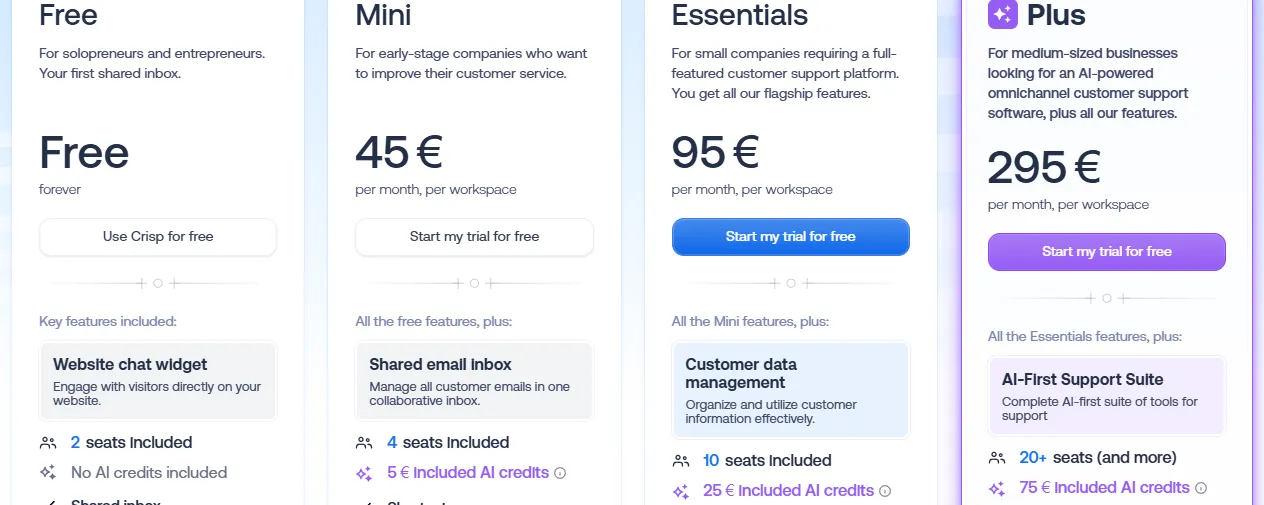
- 1 Free: no cost, but no AI credits
- 2 Mini: €45 a month per workspace (not per user)
- 3 Included AI credits: €5 on the Mini plan, more on larger plans
The second is a custom integration on Intercom, Zendesk or Freshdesk. The monthly fee starts at a few dozen euros per user (for example, Intercom from $29 per seat per month plus $0.99 per Fin AI Agent resolution, as of October 2026), and the one-off work is €800–2,500 for CRM integrations and configuring a Lithuanian system prompt. It suits teams that already use these platforms for sales or support. You can read past conversations, turn on an AI agent (for example, Intercom Fin), automatically fill CRM fields with customer data, and track the AI deflection rate in a monthly report.
The third is a fully custom solution on the OpenAI API (the Responses API: OpenAI has announced that the Assistants API will be shut down on August 26, 2026) or Anthropic Claude (with MCP tools). The one-off investment is €2,000–6,000, and the variable monthly cost is €15–80 depending on conversation volume and the model used. It suits companies that want 100% control, a custom UI in their own brand, and deep integration with internal systems: an internal order database, a custom CRM, Lithuanian accounting SaaS (Centas, Rivile, AGNUM) or a bank's PSD2 API.
A detailed price ladder comparing Tidio, Intercom and custom OpenAI solutions, with specific Lithuanian 2026 amounts, monthly costs and one-off integration prices, is in this article (AI chatbot for website cost in Lithuania 2026). It covers four price levels from €0 to €2,000+ and matches the best-fitting scenario to each type.
Customer service chatbot FAQ
What is the minimum number of customer enquiries for a chatbot to pay off? The practical threshold for Lithuanian small and medium companies is 50 recurring enquiries a month through one channel. Below this threshold the investment (€500–2,000 one-off + €30–60 a month) takes more than 12 months to pay back, and it is often simpler to hire a part-time support person for 4–8 h a week to cover the peaks.
Can a small restaurant or beauty salon manage without an IT specialist during setup? Yes, if it chooses Tidio with a ready-made Booksy or Reservio integration, or Smartsupp with a Google Sheets webhook configuration. All of these paths have visual setup wizards. Setup takes 1–3 days, not weeks. Only a custom OpenAI solution requires a qualified integrator.
Does a chatbot speak Lithuanian well enough in 2026? The GPT-4o, Claude 3.5 Sonnet and Claude Opus 4.x models write clean Lithuanian with good grammar and context, provided the system prompt is written correctly (for example, it clearly says "always reply formally using the polite 'Jūs' form, never the informal 'tu'"). The Lithuanian quality of ready-made SaaS bots (Tidio Lyro, Intercom Fin, ManyChat) varies, so be sure to test them with your real questions before buying.
What should you do if the chatbot gives a customer wrong information? First, add a rule to the system prompt: "do not answer questions about prices or return terms if they are not in the source documents; escalate to a person instead". Second, once a month review the low-confidence conversations flagged in the audit log. Third, all of the riskiest enquiry types (complaints, legal questions, health data) are automatically escalated to a person through the handoff flow.
How long does it take before a chatbot actually starts saving time? A typical Lithuanian project shows a visible effect in 4–8 weeks: the first 1–2 weeks go to technical setup and preparing the FAQ, weeks 2–4 to tuning based on real conversations and fixing the system prompt, and by weeks 5–8 the bot already handles a share (often a significant one) of incoming enquiries on its own. You measure the full ROI in the third month, when you have three full reporting cycles with the deflection rate.
Next steps
If you are considering your first customer service chatbot project for your Lithuanian business, I recommend starting in three steps. First, spend one week measuring how many recurring questions you get per month (go through the last 30 days of your email inbox, Messenger and Instagram DMs and count them by category). Second, if the number exceeds 50 per channel, choose a buying path using the three-option matrix above. Third, allow 4–8 weeks for real tuning and only then measure ROI, not right after launch day.
Aigentas helps Lithuanian small and medium companies set up customer service chatbots at all three buying levels, from a Tidio embed to a fully custom OpenAI API solution with CRM and booking system integrations. A demo before the contract: no advance payment until you see a working solution on your real data, in Lithuanian and with your FAQ base. Write to me (free consultation) about how many similar enquiries you get each month and through which channels. I will read it and reply by email whether you are above the 50-a-month threshold and which buying path is closest to your needs. If needed, we will arrange a call, and we will agree on the estimate in writing before starting.